A pricing and liquidity model for wireless spectrum
Vanderbilt Dry Dock Venture Studio Hackathon, May 2026
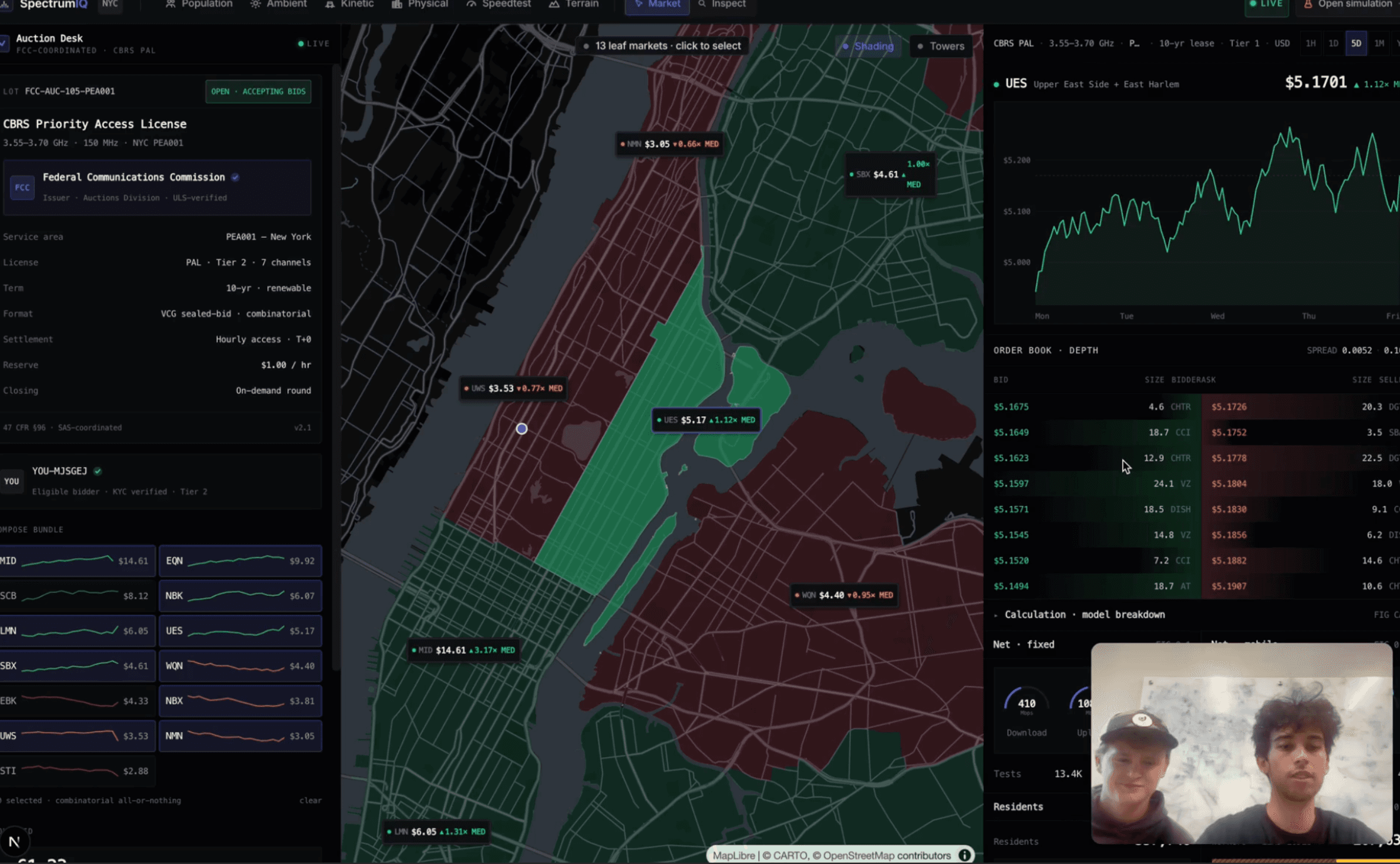
Our team won 1st place overall at Vanderbilt's Dry Dock Venture Studio Hackathon, taking home $45,000 for the overall win plus another $5,000for the Xtremis.AI Challenge. As part of the prize we're heading to NYC Tech Week to pitch VCs alongside Lorimer Ventures, with additional support from Cooley, Rho, HubSpot, and $25K in Microsoft Azure credits to keep building.
The project was a spectrum pricing and liquidity model built with Xtremis. The pitch is simple: wireless spectrum is one of the most valuable assets in the modern economy. The U.S. has auctioned over $258 billion of it, yet it trades almost nothing like an asset. There is no standard unit, no benchmark price, and no working market for short-term local access. Huge portions of it sit unused because the paperwork to lease it out is worth more than the lease itself. Dead capital.
What we built is the framework for a real-time exchange that would turn that dead capital into a tradable, liquid asset class. Three pieces: a standard unit, a way to price the unit before a market exists, and a market mechanism to clear it.
Defining the unit
The core primitive is a four-dimensional vector:
v = ⟨location, frequency, time duration, priority⟩
Location uses Google's S2 spherical grid, the same spatial indexing the mapping world has already standardized on, so any polygon on Earth is addressable. Frequency is a center frequency plus a channel width in MHz. Time duration is a multiple of the auction micro-interval (five minutes). Priority is the interesting one: instead of the FCC's rigid three-tier legal hierarchy, we defined it as a continuous SLA, a max interruption probability paired with an evacuation latency in milliseconds. A hospital that needs ⟨0.01, 50ms⟩ can express its risk tolerance directly, and the market can price it.
Pricing before there's a market
The chicken-and-egg problem with any new exchange: nobody trades without a price signal, but there's no price signal until people trade. We handled it with a liquidity-aware hybrid:
FinalPrice = (1 − ELC) × FundamentalPrice + ELC × MarketPrice
The FundamentalPrice is a first-principles anchor built from public data: FCC auction results, population, network performance proxies from Ookla and the FCC broadband map, congestion and scarcity adjustments. The MarketPrice is a live blend of weighted clearing prices and the order book. Effective Liquidity Confidence (ELC) is a scalar between 0 and 1 that says how much to trust the market signal versus the anchor. In an empty market ELC is near zero and pricing is model-driven; as real trades pile up, ELC climbs and the market takes over. The model gracefully hands the wheel to reality.
Clearing the market
Spectrum has an exposure problem: a buyer only wants Area A if they also get Area B, otherwise the purchase is worthless. Traditional item-by-item auctions let a bidder get stranded with half a bundle. The solution, well known in auction theory and worth two recent Nobels, is a combinatorial auction where bidders bid on whole bundles, and you either win the bundle or pay nothing.
The catch is the bid-shading problem: in a normal combinatorial auction, the rational move is to bid below your true valuation, which corrupts price discovery. The fix is the Vickrey–Clarke–Groves mechanism, where winners pay the opportunity cost their win imposes on everyone else rather than what they bid. Under VCG the dominant strategy is to bid your honest valuation, which is exactly what a healthy market needs.
VCG has always been theoretically beautiful and computationally brutal. The winner-determination problem is NP-hard. Our contribution was a Dynamic Market Partitioning Model that makes it feasible in practice. Instead of solving the auction across 416 fixed FCC regions, we cluster adjacent cells by price homogeneity using the coefficient of variation of their clearing prices. High-CV markets split along their longest axis; low-CV neighbors merge. The partition redraws itself after every session as real prices come in, converging toward regions that are internally consistent and, crucially, small enough for the VCG solver to actually finish.
To bootstrap the partitions before real trades exist, we ran Monte Carlo simulations with AI agents playing stakeholder archetypes (incumbent carriers, private 5G providers, event venues, federal agencies), each with a utility function derived from their real economic incentives.
Where it goes
Everything we built is a starting point, not a finished system. The pricing model is heuristic today because there's no historical transaction data to learn from; the interesting version of it is the one that gets replaced by regression the moment the exchange produces enough trades. The market design is theoretically clean but will lean on approximate solvers to hit real-time. And a working spot market is the precondition for the real prize: derivatives like forwards, futures, and options on spectrum access, same shape as electricity or oil markets today. That's where billions in dead capital start moving.
Team: Thomas J. Paige, Sam McFarland, Thomas Hung, and me. Mentored by B. Thomas Edman and Baxter Webb. Thanks to Xtremis, Cooley, Lorimer Ventures, Rho, HubSpot, and Microsoft for the support.